Shakespearean Demons, American Ears: How Onimusha's English Dub Did the Translation Work

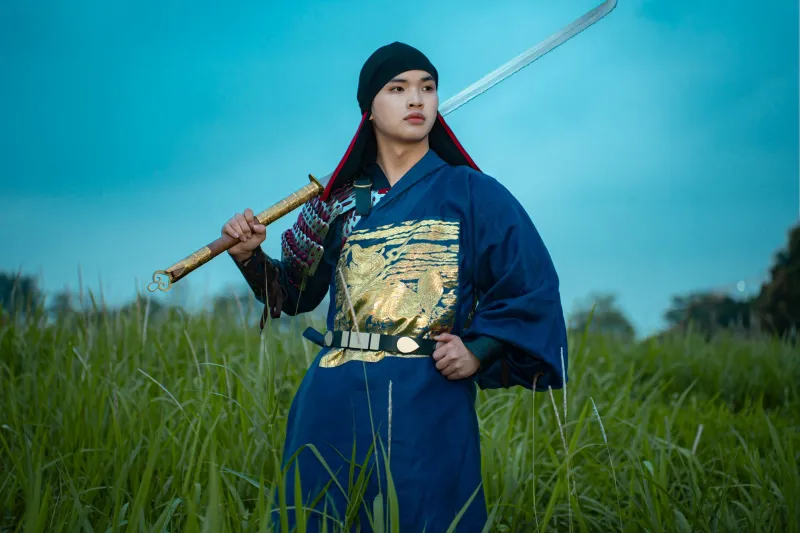
Photo by Photo by Bobby Balle on Unsplash on Unsplash
The Onimusha English dub has been a punchline for twenty-five years. The mouths don't match, the line readings land a beat late, and somebody definitely said the word "demon" with too much conviction. All fair. And all beside the point, because that dub was doing real translation work in a way that most people never gave it credit for.
For a US player who picked up Onimusha: Warlords off a shelf at Electronics Boutique in 2001, that English track was the difference between a fascinating foreign object and a game you could actually follow. Here's what it pulled off, and what it flattened along the way.
The demons got the Western canon
The most elegant localization decision in the series isn't a line reading at all — it's the naming. The Genma brass are called Marcellus, Osric, Guildenstern, Fortinbras, Hecuba. That's Hamlet and Greek tragedy, the stuff a lot of American players had been force-fed in high school English class. Meanwhile the heroes keep their names: Samanosuke, Kaede, Yuki, Jubei.
You don't need a single line of expository dialogue to get the message. The villains speak the language of the Western literary tradition. The protagonists belong to a tradition the player is visiting, not inheriting. The game sorted its cast for you using cultural furniture you already owned, and it did it without a lore codex or a character-relationship menu.
That's localization as narrative architecture, and it's far more interesting than the usual debate about whether a translation is "accurate."
The box copy was translation too
Subtitles did work the dub couldn't. "Warlords" told a shelf-shopper this was about power and sieges. "Samurai's Destiny" promised a personal story. "Demon Siege" promised spectacle. Capcom's US packaging wasn't shy about selling genre, and for an audience that had to be talked into feudal Japan, that was the right call. Compare it to the Japanese releases, which could simply say Onimusha and assume the audience knew what an oni was.
What the line readings actually did
The performances are clipped. Declarative. Occasionally wooden. And weirdly, that read as discipline to a generation raised on Kurosawa dubs and late-night samurai films on cable. A stoic swordsman who speaks in flat, deliberate sentences scans as controlled, not bored. The stiffness accidentally became characterization.
Then there's the shouty stuff — the incantations, the demon taunts, the way the villains announce themselves with theatrical relish. In Japanese those lines carry register and rhythm that a subtitle can't fully transmit. In English they became cartoonish, which is exactly what a 2001 action game needed its bad guys to be. You knew who the villain was the second he opened his mouth. That's a design win disguised as a dub flaw.
What got lost in the trade
Plenty. Honorifics vanished. The layered registers of Japanese address — the way a retainer speaks to a lord versus how a rival speaks to a rival — collapsed into "my lord" and "you." Jokes that depended on formality didn't survive. The dub traded nuance for legibility, which is a defensible trade but a trade nonetheless.
The point isn't that the trade was free. It's that it was deliberate, and it served an audience that needed a door into a setting they had no context for. Legibility is not the enemy of art. It's usually the prerequisite.
What 2026 localizations should steal from it
Two things, and they're both about restraint.
First, keep the artifact. When a classic gets remastered, the original English track should be there as a selectable option, not quietly replaced by a new dub that smooths out everything interesting about the old one. New players deserve to hear the version that made people fall for the series, warts and all. Offer the fresh take as an alternative, never as an erasure.
Second, trust the audience with names. The Genma don't need to be renamed into something more pronounceable, and Samanosuke doesn't need a nickname. The 2001 localization understood that a little friction at the door buys a lot of atmosphere once you're inside. Modern localizations, terrified of confusing anyone, sand that friction away — and the setting ends up feeling like a theme park rather than a place.
The Onimusha dub is a time capsule of a moment when American publishers assumed their audience was smart enough to handle a foreign setting, and charmingly clumsy enough to help them get there. Stiff, yes. But it sold feudal Japan to a country that had never asked for it, and that's not nothing.